A version of this piece was first published in the spring 2026 edition of the Fabian Review.
Christian nationalism seeks to fuse politics with Christianity and have the government promote or actively enforce religious interests and policies. It is opposed to the separation of church and state and to all forms of pluralism, such as learning about other beliefs and cultures. Christian nationalists advocate ultra conservative Christian social policies, such as opposing the human rights of women, LGBT+ people, and rights to bodily autonomy in areas like abortion and assisted dying. Many British progressives feel horror at the movement’s many policy successes in the US: not just the abortion bans and the library censorship, but the bigger philosophical victory reflected in official rhetoric of the US as a Christian nation and a global security strategy that seeks to export that Christian nationalism. But should our horror now turn into domestic apprehension?
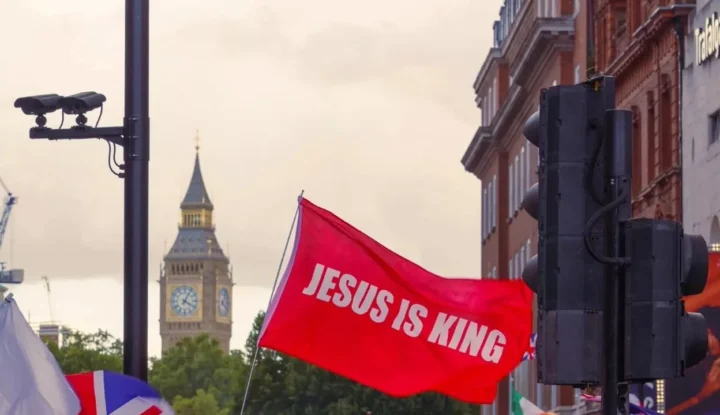
At Tommy Robinson’s London rally in September 2025, marchers hoisted Christian crosses and flags proclaiming “Christ is King” while a banner with “humanism” and “no religion” printed on it was ceremonially torn up. A few weeks later, blackshirted members of a group calling themselves ‘The King’s Army’ marched in a military formation on Old Compton Street, London’s busiest street for LGBT+ venues, shouting ‘Jesus Saves’ and other slogans. Founded in 2024, the group describes itself as a ‘spiritual army’ opposed to ‘sin and cultural decay’, and ‘a coalition of Christians… who believe it’s time for the Church to stop living like civilians and start fighting like soldiers’. The rally was promoted online by Turning Point UK, a Christian nationalist organisation based on the organisation founded by Charlie Kirk in the United States – just one of the US-inspired or funded Christian nationalist organisations now operating in Britain. It is not just on the street but at the top of politics that this tendency is rampant. Danny Kruger, until the defection of Robert Jenrick perhaps the most notable former Conservative to join Reform UK, has called for Christians to ‘destroy’ and ‘banish from public life’ a ‘woke’ modern creed combining ‘ancient paganism, Christian heresies, and the cult of modernism’. The “National Conservatism” movement which is hothousing a new generation of right wing activists is drenched in Christian nationalism and its UK Chairman is a key adviser to the leader of Reform UK, the political party currently leading voting intention polls.
There is plenty of money for all this. In 2020, openDemocracy reported that a variety of American evangelical groups had spent over $280 million on European advocacy. That total has only risen. The Alliance Defending Freedom (ADF), a US-based Christian advocacy group, has doubled its spending in the UK. Paul Marshall, the new owner of the most popular periodical of the right, The Spectator, has said that ‘traditional British liberalism rests on the Judeo-Christian understanding that we are all, in moral terms, fallen creatures… Somewhere amid the arrogance of the Enlightenment, we lost this sense of fallenness’. His other investments include the Church Revitalisation Trust whose stated aim is ‘The Evangelisation of the Nation, The Revitalisation of the Church, The Transformation of Society’.
So will the UK follow where the US is leading?
“It couldn’t happen here. Britain is different,” we always said when contemplating the old US Religious Right. And in some important ways, of course, we are different. In the US, although it is also becoming less religious each generation, most people do still identify as Christian. In contrast, Britain is not a Christian country in any meaningful way. Surveys show that over 90% of people don’t attend Christian services, over 70% of people don’t have a Christian belief system, and over 60% of people don’t have a Christian identity. Our national culture, though of course shaped in part (for good and ill) by some Christian ideas and values, has also been shaped by pre-Christian, non-Christian, and post-Christian ideas (with the latter having done more than any other beliefs and values to shape our modern social democracy). We have among the lowest levels of religious belief, practice, and identity in the free world and certainly significantly lower than in the US.
Our basic constitutions and histories are very different too. The US has been, from its beginning, a nation in which political Christianity has vied vigorously against the progressive tendency. It’s true that the constitution adopted in 1788 was secular and in 1791 the First Amendment stated that the legislature, among other things, could “make no law respecting an establishment of religion, or prohibiting the free exercise thereof…” This aimed to set in stone the principle that President John Adams in 1797 expressed as “the Government of the United States of America is not, in any sense, founded on the Christian Religion” and Thomas Jefferson in 1802 celebrated as, “a wall of separation between Church and State”. On the other hand, none of this was uncontroversial. From the 1860s the National Reform Association lobbied for the inclusion of Christianity in the Constitution and although they were unsuccessful, proposals for its ‘Christian Amendment’ were discussed by Congress many times. Similar proposals sponsored by evangelical Protestants were brought throughout the twentieth century with similar lack of success, but smaller campaigns in the nineteenth and twentieth centuries to add ‘In God We Trust’ to coins and paper currency and in 1954 the phrase ‘under God’ to the Pledge of Allegiance were successful.
In the UK, by contrast, a technical constitutional Christian nationalist has little to complain about. We are a Christian state that on paper a US Christian nationalist would give their right arm for. Our head of state has to be Christian by law, all our national ceremonies from remembrance to state occasions are presided over exclusively by Christian priests, most of our state schools are mandated by law to have Christian worship, state schools can show preference to the children of Christian parents on admission, state hospitals and prisons have Christian chaplains at public expense, the law mandates that most school curricula about religion and philosophy must give priority to Christianity, and every day the proceedings of our national parliament begin with Christian prayers presided over by the state church. That same parliament contains voting representatives of the state religion – a constitutional outrage mirrored only in Iran. But in spite of our theocratic constitution, the trajectory of our recent history has been in the other direction from the US. A pragmatic lawlessness means that rules on worship in schools and others are mostly flouted, and the state church for the last 150 years or so, while maintaining its staggering wealth and elite influence and resisting change for as long as it can, has largely bowed before a progressive secular tendency that has created a space for increasing freedom of conscience in practice.
So we seem to have two very different situations. In the US most people are still Christians and the long underlying trend has been of political Christianity slowly dissolving state secularism. In the UK most people have a non-religious worldview and progressivism has slowly rendered state Christianity a dead letter.
And yet, there are reasons to be apprehensive. Christian nationalism is not primarily a constitutional or technical project but a social and real-political one, based on rhetoric and identity. The background conditions for it exist in the UK, in spite of our non-religious society and our recent history of de facto if not de iure political secularism. Our state Christianity may even assist it. In Matlock in Derbyshire, Reform councillors reintroduced Christian prayer to council meetings on the basis that the UK was a ‘Christian country’, to progressive dismay. But how is this different from the Christian prayers every day in the House of Commons? in Northumberland, a Reform councillor on the council’s RE Committee said he wanted exclusively Christian Religious Education in schools because this was ‘a Christian country’, calling any other approach to RE ‘brainwashing’. How can we deny this goes with the grain of our national law requiring Christian worship in all schools?
The risk in Britain is a top-down, elite-formulated Christian Nationalism that seeks to weaponise white identity against modern pluralism and liberal values on the basis of vibes. For Fabians, understanding and combating this trend is no longer a side issue, but central to the fight for an open, equal, and democratic society.
The new British Christian nationalism, championed by figures on the right of the Conservative party and supported by a network of opaque think tanks, does not necessarily demand that you believe in the Resurrection. Instead, it demands that you subscribe to “Christianity” as a cultural fortress. It posits that British liberty, democracy, and rule of law are not the fruits of the Enlightenment or secular struggle, but the exclusive property of Christian heritage. By framing “Christianity” as the definition of national belonging, this ideology neatly categorises non-Christians as suspicious outsiders. When politicians argue that we must protect our “Christian culture” from immigrants or “cultural Marxists,” they are using the cross as a weapon for culture wars.
For Fabians, rooted in the patient accumulation of facts and the application of reason to social problems, this identity-based politics is particularly dangerous. The Fabian tradition relies on the belief that good governance is the product of rational inquiry, evidence-based policy, and expert administration. When dogma replaces data as the basis for policy-making, whether on public health, climate change, or education, the Fabian project of gradual, evidence-based amelioration becomes impossible. We see this already in the attacks on the administrative state where civil servants and experts are denigrated not because they are inefficient, but because their technocratic neutrality, a product of the de facto secular state, is seen as an obstacle to the reshaping of society.
Christian nationalism also strikes at the heart of the Fabian ideal of universalism. The welfare state depends on a sense of shared citizenship that transcends private beliefs. It requires a social contract where every citizen is equal before the state. Christian nationalism fractures this solidarity. It introduces a hierarchy of belonging, suggesting that the “true” citizen is the Christian (or at least the “culturally Christian”) citizen. By elevating sectarian identity over universal need, it undermines the collective ethos necessary to sustain public services.
The response to the threat lies in a robust, unapologetic commitment to secularism. For too long, many progressives have been squeamish about secularism, fearing it might be interpreted as anti-religious. We need to reclaim it. Secularism is not atheism. It is not the banning of religion. It is a framework for ensuring equality: a state where noon is privileged, or disadvantaged on account of their religion or convictions.
Combating Christian nationalism demands constitutional, policy, and cultural responses.
In terms of our constitution, it is time to finish the work of disestablishment of Christianity from our constitution. The link between Church and State, keeps the door ajar for Christian nationalism. Closing it would send a clear signal that power in modern Britain flows from the people and mark a transition from being “tolerant of others” to “equal for all”. We should re-centre human rights law and equality law as being a strength of our system, and think again about how we strengthen these aspects of our law as being quasi-constitutional.
In education, we should end the state-sponsored segregation of children by closing the loopholes that allow faith schools to discriminate in admissions and employment. The curriculum must also evolve, implementing the Commission on Religious Education’s recommendations for an objective “Religion and Worldviews” subject and we should repeal the archaic legal requirement for daily collective worship, replacing it with inclusive assemblies that celebrate shared values rather than enforcing religious observance. We should revive citizenship education and emphasise not just media literacy and rights education, but the secular basis of citizenship.
In broader terms, we must offer a compelling alternative to the “Christian Nation” narrative by building a national identity based on shared democratic values. This can be done from the government pulpit but also by local leaders. It has policy aspects (reviewing national ceremonies, from Remembrance Sunday to the Coronation, to ensure they represent the reality of modern Britain, for example) but it is mainly a project of progressive national story-telling: a state-supported cultural shift, through the BBC, national museums, and public holidays, to reinforce civic patriotism and national identity.
Christian nationalism in Britain is an attempt to turn back the clock on the social progress of recent decades. It seeks to divide citizens by culture, often to distract from the economic inequalities that plague us, which it will not solve. Many of its aspects were familiar to the first Fabians as aspects of nineteenth century protestant conservatism. Fabians today need to recognise this anew and give serious attention to forestalling a re-occupation of the still-Christian state by the enemies of progress.